Inaugural lectures at Imperial College London 2012-2013
2013
R
2 h 33 m
Britania Raya
Lainnya
Imperial's 'Meet our new professors' series is an opportunity for newly-promoted researchers who have been awarded professorships at Imperial to give an inaugural lecture to friends, colleagues, collaborators and members of the public as a chance to reflect on their career to date and share the wonder of their research. The individual lectures all have their own hashtags associated with the events. These lectures relate to the academic year 2012-2013, though professorships may have been appointed in previous promotion rounds. For more information, visit Imperial's dedicated pages:
More
0 /10
0 people rated
Inaugural lectures at Imperial College London 2012-2013
2013
R
2 h 33 m
Britania Raya
Lainnya
Imperial's 'Meet our new professors' series is an opportunity for newly-promoted researchers who have been awarded professorships at Imperial to give an inaugural lecture to friends, colleagues, collaborators and members of the public as a chance to reflect on their career to date and share the wonder of their research. The individual lectures all have their own hashtags associated with the events. These lectures relate to the academic year 2012-2013, though professorships may have been appointed in previous promotion rounds. For more information, visit Imperial's dedicated pages:
More
0 /10
0 people rated
Tonton online
Tonton di app
Watch on TV
Episode
Pemeran Terbaik
Ulasan Pengguna
Episode
Pemeran Terbaik
Ulasan Pengguna
Episode
film
lklk
Netflix
Plex
Ulasan Pengguna
Official Cleland
19/11/2025 07:05
Professor Philippa Gardner's inaugural lecture. 10 Oct 2012 Imperial College London Tracking program footprints: guaranteeing what computers do We cannot yet guarantee what computers do. Our understanding of programs has not kept pace with their increasing complexity: software licences give no guarantees; simple program errors turn into major attacks; web apps make your browser hang; and concurrent programs are too difficult to write. Mathematical reasoning techniques could provide guarantees about what programs do. However, such techniques are only just beginning to scale to large programs. In this, her inaugural lecture Professor Philippa Gardner will talk about resource reasoning, whose pivotal concept is the idea of 'footprints'. A footprint identifies the essential memory used by a program, which can be separated from the untouched memory, enabling the reasoning to scale. Professor Gardner introduces abstract resource reasoning, focusing on abstract footprints such as sets and web
Patricia Sambi
19/11/2025 07:05
Professor David Dexter talks about his research into the causes of Parkinson's and his role in the UK Brain Bank at his inaugural lecture. For more information please visit
Mïäï
19/11/2025 07:05
Professor John Dear (Mechanical Engineering) explains how research is helping us understand how materials and structures could fail under extreme conditions such as blasts. For more information please visit
Domy🍑🍑
19/11/2025 07:05
Professor Dan Crisan gives his inaugural lecture. Stochastic analysis is the branch of mathematics that looks at understanding and modelling systems that behave randomly. For more information please visit
Iamcharity3
19/11/2025 07:05
Surgeon Professor Thanos Athanasiou talks about the challenges facing cardiac surgery in the current economic climate in his inaugural lecture. For more information please visit
JAWHARI 🪡🪡
19/11/2025 07:05
Downsizing the internal combustion engine may be the key to low carbon vehicles, says Professor Ricardo Martinez-Botas (Mechanical Engineering) in his inaugural lecture. For more information please visit
La Rose😘😘😘🤣🤣🤣58436327680
19/11/2025 07:05
Physicist Professor Tim Horbury explains the science behind space plasmas and why understanding turbulence is so important. For more information please visit
SALMA.DRAWSS
19/11/2025 07:05
Several metals, including iron, cobalt, copper and zinc, are naturally present in living organisms and play essential roles in a wide range of biological processes. In addition, some metal complexes have shown to be very successful therapeutic and diagnostic agents. Examples of these are platinum-based anticancer drugs, used in chemotherapy since the 1970s, and gadolinium-based MRI contrast agents for medical imaging. For several years Ramon Vilar and his team have been studying the chemistry of metal complexes in living organisms with the aim of developing new metal-based drugs as well as gaining a better molecular understanding of biological processes. They have a particular interest in studying how novel metal complexes interact with selected enzymes and DNA. For more information please visit
Smiley💛
19/11/2025 07:05
Professor Justin Stebbing explains how finding new signalling targets for drug treatments could help prevent cancer patients relapse. For more information please visit
bilalhamdi1
19/11/2025 07:05
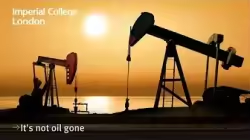
Professor Ann Muggeridge delivers her inaugural lecture on getting the last drops out of the planet's ever-decreasing oil reserves. Today crude oil forms a major source of our energy, particularly for transport, and is projected to remain so for many decades to come. It is, however, as many of us are aware, a finite resource and will eventually run out. Not only this, but the carbon dioxide produced by burning oil makes it a significant contributor to climate change. This lecture explores how oil is recovered, focussing particularly on how much conventional oil is left behind by current recovery methods and the opportunities to exploit that remaining oil through new and emerging technologies. For more information please visit
— No more content —
Ulasan Pengguna
Official Cleland
19/11/2025 07:05
Professor Philippa Gardner's inaugural lecture. 10 Oct 2012 Imperial College London Tracking program footprints: guaranteeing what computers do We cannot yet guarantee what computers do. Our understanding of programs has not kept pace with their increasing complexity: software licences give no guarantees; simple program errors turn into major attacks; web apps make your browser hang; and concurrent programs are too difficult to write. Mathematical reasoning techniques could provide guarantees about what programs do. However, such techniques are only just beginning to scale to large programs. In this, her inaugural lecture Professor Philippa Gardner will talk about resource reasoning, whose pivotal concept is the idea of 'footprints'. A footprint identifies the essential memory used by a program, which can be separated from the untouched memory, enabling the reasoning to scale. Professor Gardner introduces abstract resource reasoning, focusing on abstract footprints such as sets and web
Patricia Sambi
19/11/2025 07:05
Professor David Dexter talks about his research into the causes of Parkinson's and his role in the UK Brain Bank at his inaugural lecture. For more information please visit
Mïäï
19/11/2025 07:05
Professor John Dear (Mechanical Engineering) explains how research is helping us understand how materials and structures could fail under extreme conditions such as blasts. For more information please visit
Domy🍑🍑
19/11/2025 07:05
Professor Dan Crisan gives his inaugural lecture. Stochastic analysis is the branch of mathematics that looks at understanding and modelling systems that behave randomly. For more information please visit
Iamcharity3
19/11/2025 07:05
Surgeon Professor Thanos Athanasiou talks about the challenges facing cardiac surgery in the current economic climate in his inaugural lecture. For more information please visit
JAWHARI 🪡🪡
19/11/2025 07:05
Downsizing the internal combustion engine may be the key to low carbon vehicles, says Professor Ricardo Martinez-Botas (Mechanical Engineering) in his inaugural lecture. For more information please visit
La Rose😘😘😘🤣🤣🤣58436327680
19/11/2025 07:05
Physicist Professor Tim Horbury explains the science behind space plasmas and why understanding turbulence is so important. For more information please visit
SALMA.DRAWSS
19/11/2025 07:05
Several metals, including iron, cobalt, copper and zinc, are naturally present in living organisms and play essential roles in a wide range of biological processes. In addition, some metal complexes have shown to be very successful therapeutic and diagnostic agents. Examples of these are platinum-based anticancer drugs, used in chemotherapy since the 1970s, and gadolinium-based MRI contrast agents for medical imaging. For several years Ramon Vilar and his team have been studying the chemistry of metal complexes in living organisms with the aim of developing new metal-based drugs as well as gaining a better molecular understanding of biological processes. They have a particular interest in studying how novel metal complexes interact with selected enzymes and DNA. For more information please visit
Smiley💛
19/11/2025 07:05
Professor Justin Stebbing explains how finding new signalling targets for drug treatments could help prevent cancer patients relapse. For more information please visit
bilalhamdi1
19/11/2025 07:05
Professor Ann Muggeridge delivers her inaugural lecture on getting the last drops out of the planet's ever-decreasing oil reserves. Today crude oil forms a major source of our energy, particularly for transport, and is projected to remain so for many decades to come. It is, however, as many of us are aware, a finite resource and will eventually run out. Not only this, but the carbon dioxide produced by burning oil makes it a significant contributor to climate change. This lecture explores how oil is recovered, focussing particularly on how much conventional oil is left behind by current recovery methods and the opportunities to exploit that remaining oil through new and emerging technologies. For more information please visit
— No more content —
Disclaimer: All videos and pictures on MovieBox are from the Internet, and their copyrights belong to the original creators. We only provide webpage services and do not store, record, or upload any content.


 Nikmati film dan acara tanpa batas
 Download konten favorit untuk ditonton offline
 Tampilan mudah, lancar dipakai
'%20stroke-width='1.5'/%3e%3cpath%20d='M7%2017H13M10%2014.75V17'%20stroke='url(%23paint1)'%20stroke-width='1.5'%20stroke-linecap='round'/%3e%3cpath%20d='M10%206V11M10%2011L12%209M10%2011L8%209'%20stroke='url(%23paint2)'%20stroke-width='1.5'%20stroke-linecap='round'%20stroke-linejoin='round'/%3e%3cdefs%3e%3clinearGradient%20id='paint0'%20x1='2'%20y1='9'%20x2='18'%20y2='9'%20gradientUnits='userSpaceOnUse'%3e%3cstop%20stop-color='%231CB7FF'/%3e%3cstop%20offset='0.5'%20stop-color='%232FF58B'/%3e%3c/linearGradient%3e%3clinearGradient%20id='paint1'%20x1='7'%20y1='15.9'%20x2='13'%20y2='15.9'%20gradientUnits='userSpaceOnUse'%3e%3cstop%20stop-color='%231CB7FF'/%3e%3cstop%20offset='0.5'%20stop-color='%232FF58B'/%3e%3c/linearGradient%3e%3clinearGradient%20id='paint2'%20x1='8'%20y1='8.5'%20x2='12'%20y2='8.5'%20gradientUnits='userSpaceOnUse'%3e%3cstop%20stop-color='%231CB7FF'/%3e%3cstop%20offset='0.5'%20stop-color='%232FF58B'/%3e%3c/linearGradient%3e%3c/defs%3e%3c/svg%3e)
'/%3e%3cdefs%3e%3clinearGradient%20id='paint0'%20x1='2.5'%20y1='10'%20x2='17.5'%20y2='10'%20gradientUnits='userSpaceOnUse'%3e%3cstop%20stop-color='%231CB7FF'/%3e%3cstop%20offset='0.5'%20stop-color='%232FF58B'/%3e%3c/linearGradient%3e%3c/defs%3e%3c/svg%3e)




'%3e%3cpath%20id='Vector'%20d='M17.3996%2025.7999C17.3996%2025.9838%2017.3634%2026.1658%2017.293%2026.3357C17.2227%2026.5055%2017.1196%2026.6598%2016.9896%2026.7899C16.8596%2026.9199%2016.7052%2027.023%2016.5354%2027.0933C16.3655%2027.1637%2016.1835%2027.1999%2015.9996%2027.1999C15.8158%2027.1999%2015.6337%2027.1637%2015.4639%2027.0933C15.294%2027.023%2015.1397%2026.9199%2015.0097%2026.7899C14.8797%2026.6598%2014.7765%2026.5055%2014.7062%2026.3357C14.6358%2026.1658%2014.5996%2025.9838%2014.5996%2025.7999C14.5996%2025.4286%2014.7471%2025.0725%2015.0097%2024.81C15.2722%2024.5474%2015.6283%2024.3999%2015.9996%2024.3999C16.3709%2024.3999%2016.727%2024.5474%2016.9896%2024.81C17.2521%2025.0725%2017.3996%2025.4286%2017.3996%2025.7999Z'%20fill='white'/%3e%3cpath%20id='Union'%20fill-rule='evenodd'%20clip-rule='evenodd'%20d='M8.5%204H23.5C24.0523%204%2024.5%204.44772%2024.5%205V21.5H7.5V5C7.5%204.44772%207.94772%204%208.5%204ZM5.5%2022.5V5C5.5%203.34315%206.84315%202%208.5%202H23.5C25.1569%202%2026.5%203.34315%2026.5%205V22.5V27C26.5%2028.6569%2025.1569%2030%2023.5%2030H8.5C6.84315%2030%205.5%2028.6569%205.5%2027V22.5ZM24.5%2023.5V27C24.5%2027.5523%2024.0523%2028%2023.5%2028H8.5C7.94772%2028%207.5%2027.5523%207.5%2027V23.5H24.5Z'%20fill='white'/%3e%3cpath%20id='Union_2'%20fill-rule='evenodd'%20clip-rule='evenodd'%20d='M17%209C17%208.44772%2016.5523%208%2016%208C15.4477%208%2015%208.44772%2015%209V13.8258L13.1508%2012.2407C12.7315%2011.8813%2012.1002%2011.9299%2011.7408%2012.3492C11.3813%2012.7685%2011.4299%2013.3998%2011.8492%2013.7593L15.345%2016.7556C15.5205%2016.9079%2015.7495%2017%2016%2017C16.2506%2017%2016.4796%2016.9079%2016.6551%2016.7556L20.1508%2013.7593C20.5701%2013.3998%2020.6187%2012.7685%2020.2593%2012.3492C19.8999%2011.9299%2019.2686%2011.8813%2018.8492%2012.2407L17%2013.8258V9Z'%20fill='white'/%3e%3c/g%3e%3c/svg%3e)