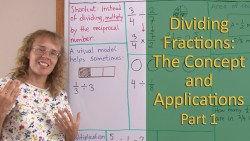
I review the shortcut for fraction division with one problem, and then we look at a few connecting concepts: * how sometimes a visual model can help us solve a fraction division problem - it essentially becomes mental math (1/3 divided by 3) * Again, how simple logical reasoning can help us solve 4 divided by 1/8 * how multiplication can SOMETIMES be used to solve division problems. This of course doesn't usually work, but students need to be WELL aware of the connection between multiplication and division, so I included 2 examples just to refresh that thought in their minds. The 2nd part of this lesson is here:
More
0 /10
0 people rated
Fraction division
2019
R
0 h 27 m
متحدہ سلطنت یونائیٹڈ کنگڈم
ریاضی
I review the shortcut for fraction division with one problem, and then we look at a few connecting concepts: * how sometimes a visual model can help us solve a fraction division problem - it essentially becomes mental math (1/3 divided by 3) * Again, how simple logical reasoning can help us solve 4 divided by 1/8 * how multiplication can SOMETIMES be used to solve division problems. This of course doesn't usually work, but students need to be WELL aware of the connection between multiplication and division, so I included 2 examples just to refresh that thought in their minds. The 2nd part of this lesson is here:
More
0 /10
0 people rated
آن لائن دیکھیں
ایپ میں دیکھیں
Watch on TV
اقساط
ٹاپ کاسٹ
صارف کا جائزہ
اقساط
ٹاپ کاسٹ
صارف کا جائزہ
اقساط
film
lklk
Netflix
Plex
صارف کا جائزہ
Nunkwin
22/10/2025 20:48
In this problem, we're given the aspect ratio of a rectangle as being 5:3, and its perimeter as 4 inches. The task is to find the side lengths and the area. This involves fraction division and multiplication.
user9761558442215
22/10/2025 20:48
In this problem, we're given the aspect ratio of a rectangle as being 5:3, and its perimeter as 4 inches. The task is to find the side lengths and the area. This involves fraction division and multiplication.
Zano Uirab
22/10/2025 20:48
A word problem: how many 3 3/4 inch pieces of ribbon can you cut out of 3 ft 2 in of ribbon? Ultimately this is about fraction division, but we first have to make sure our quantities have the same unit (inches). The second part of this problem solving lesson is found here: See more 6th grade math videos at
Ladislao_9
22/10/2025 20:48
A word problem: how many 3 3/4 inch pieces of ribbon can you cut out of 3 ft 2 in of ribbon? Ultimately this is about fraction division, but we first have to make sure our quantities have the same unit (inches). The second part of this problem solving lesson is found here: See more 6th grade math videos at
khuMz AleEy
22/10/2025 20:48
First we study reciprocal numbers: if the product of two numbers is 1, they are reciprocal numbers. From this, we can see that the answer to the division 1 divided by (3/4) will be the reciprocal of 3/4, or 4/3. DIVISION as a process has to do with "fitting": how many times does (the divisor) FIT into the (dividend). This is the thought that we develop in trying to understand WHY the common shortcut for fraction division works (the shortcut being, instead of dividing, multiply by the reciprocal of the divisor). Some students may find the explanation a bit confusing, which is alright. You can use the shortcut without understanding all these details, but it is always nice if you CAN grasp how and why things work "behind the scenes". That's what makes math fascinating!
pas de nom 🤭😝💙
22/10/2025 20:48
First we study reciprocal numbers: if the product of two numbers is 1, they are reciprocal numbers. From this, we can see that the answer to the division 1 divided by (3/4) will be the reciprocal of 3/4, or 4/3. DIVISION as a process has to do with "fitting": how many times does (the divisor) FIT into the (dividend). This is the thought that we develop in trying to understand WHY the common shortcut for fraction division works (the shortcut being, instead of dividing, multiply by the reciprocal of the divisor). Some students may find the explanation a bit confusing, which is alright. You can use the shortcut without understanding all these details, but it is always nice if you CAN grasp how and why things work "behind the scenes". That's what makes math fascinating!
محمد رشاد
22/10/2025 20:48
In this second part we tackle a problem about the area of a rectangle, with fractional side lengths and area. Since area is found by multiplying the side lengths, to solve for an unknown SIDE, we have to use division of fractions. Then, I solve a simple multiplication equation that involves fractions - which naturally is solved by fraction division. Lastly we look at serving size problems... how many 1/2 cup servings of yogurt can you get out of so much yogurt? This is solved with division. The first part of this lesson is here:
lamiez Holworthy Dj
22/10/2025 20:48
In this second part we tackle a problem about the area of a rectangle, with fractional side lengths and area. Since area is found by multiplying the side lengths, to solve for an unknown SIDE, we have to use division of fractions. Then, I solve a simple multiplication equation that involves fractions - which naturally is solved by fraction division. Lastly we look at serving size problems... how many 1/2 cup servings of yogurt can you get out of so much yogurt? This is solved with division. The first part of this lesson is here:
Seargio Muller
22/10/2025 20:48
I review the shortcut for fraction division with one problem, and then we look at a few connecting concepts: * how sometimes a visual model can help us solve a fraction division problem - it essentially becomes mental math (1/3 divided by 3) * Again, how simple logical reasoning can help us solve 4 divided by 1/8 * how multiplication can SOMETIMES be used to solve division problems. This of course doesn't usually work, but students need to be WELL aware of the connection between multiplication and division, so I included 2 examples just to refresh that thought in their minds. The 2nd part of this lesson is here:
Iniedo
22/10/2025 20:48
I review the shortcut for fraction division with one problem, and then we look at a few connecting concepts: * how sometimes a visual model can help us solve a fraction division problem - it essentially becomes mental math (1/3 divided by 3) * Again, how simple logical reasoning can help us solve 4 divided by 1/8 * how multiplication can SOMETIMES be used to solve division problems. This of course doesn't usually work, but students need to be WELL aware of the connection between multiplication and division, so I included 2 examples just to refresh that thought in their minds. The 2nd part of this lesson is here:
— No more content —
Disclaimer: All videos and pictures on MovieBox are from the Internet, and their copyrights belong to the original creators. We only provide webpage services and do not store, record, or upload any content.


 لامحدود فلمیں اور شوز دیکھیں
 اپنا پسندیدہ مواد ڈاؤن لوڈ کریں اور آف لائن دیکھیں
 آسان انٹرفیس اور ہموار کارکردگی