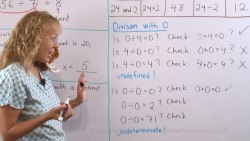
I explain the terms dividend, divisor, and quotient plus we practice those a little. Then we delve into the problems in division by zero. Instead of just announcing that "You cannot divide by zero", I explain WHY that is. Because of the problems, dividing by zero is "undefined". Lastly we look at zero divided by zero, and why that ends up being "undetermined"... essentially, there could be many possible answers that would work, so 0/0 is termed (by mathematicians) "undetermined". Check out also my other videos for division-related topics at
More
0 /10
0 people rated
Division terms, factors, primes - 4th grade
2018
R
0 h 30 m
United Kingdom
Math
I explain the terms dividend, divisor, and quotient plus we practice those a little. Then we delve into the problems in division by zero. Instead of just announcing that "You cannot divide by zero", I explain WHY that is. Because of the problems, dividing by zero is "undefined". Lastly we look at zero divided by zero, and why that ends up being "undetermined"... essentially, there could be many possible answers that would work, so 0/0 is termed (by mathematicians) "undetermined". Check out also my other videos for division-related topics at
More
0 /10
0 people rated
Watch Online
Watch in App
Watch on TV
Episodes
Top Cast
User Review
Episodes
Top Cast
User Review
Episodes
film
lklk
Netflix
Plex
User Review
LesDegameursofficiels
22/10/2025 20:49
In this lesson we have a chart for numbers 1-30, and I check whether each of them is divisible by 1, 2, 3, 4, 5, 6, 7, 8, and 9. The larger numbers didn't fit, but not to worry, our check is sufficient to find all the primes between 1 and 30: they are numbers that are only divisible by 1 and by themselves. Lastly we check whether 79 and 87 are prime or composite numbers, based on divisibility. This lesson is meant for 4th grade math. The first part of the lesson explains the terms factor, multiple, and divisible, and it is found here:
Jacqueline
22/10/2025 20:49
In this lesson we have a chart for numbers 1-30, and I check whether each of them is divisible by 1, 2, 3, 4, 5, 6, 7, 8, and 9. The larger numbers didn't fit, but not to worry, our check is sufficient to find all the primes between 1 and 30: they are numbers that are only divisible by 1 and by themselves. Lastly we check whether 79 and 87 are prime or composite numbers, based on divisibility. This lesson is meant for 4th grade math. The first part of the lesson explains the terms factor, multiple, and divisible, and it is found here:
Blackmax
22/10/2025 20:49
I explain a systematic way of finding all the factors of a given number. Basically, we check whether numbers 2, 3, 4, 5, and so on are factors of the number, and every time we find a factor, we write the multiplication and write down both factors. Going through the counting numbers in order, at some point you will know that you will have found all the factors, because the large factors will "meet" the small factors. It's much easier to understand by an example so please watch the video. This topic is first encountered in 4th grade math (in Common Core) but may be in some other grade/year in other countries/standards.
Franzy Bettyna
22/10/2025 20:49
I explain a systematic way of finding all the factors of a given number. Basically, we check whether numbers 2, 3, 4, 5, and so on are factors of the number, and every time we find a factor, we write the multiplication and write down both factors. Going through the counting numbers in order, at some point you will know that you will have found all the factors, because the large factors will "meet" the small factors. It's much easier to understand by an example so please watch the video. This topic is first encountered in 4th grade math (in Common Core) but may be in some other grade/year in other countries/standards.
❤️Delhi_Wali❤️
22/10/2025 20:49
Learn some basic terminology related to numbers and divisibility: What does it mean when one number is factor of another, when a number is a multiple of another, or a number is divisible by another. This lesson is meant for 4th grade math. The second part of the lesson is found at In it, we find out what prime numbers are. :)
Nana Ama Kakraba
22/10/2025 20:49
Learn some basic terminology related to numbers and divisibility: What does it mean when one number is factor of another, when a number is a multiple of another, or a number is divisible by another. This lesson is meant for 4th grade math. The second part of the lesson is found at In it, we find out what prime numbers are. :)
Sarah.family
22/10/2025 20:49
I explain the terms dividend, divisor, and quotient plus we practice those a little. Then we delve into the problems in division by zero. Instead of just announcing that "You cannot divide by zero", I explain WHY that is. Because of the problems, dividing by zero is "undefined". Lastly we look at zero divided by zero, and why that ends up being "undetermined"... essentially, there could be many possible answers that would work, so 0/0 is termed (by mathematicians) "undetermined". Check out also my other videos for division-related topics at
2KD
22/10/2025 20:49
I explain the terms dividend, divisor, and quotient plus we practice those a little. Then we delve into the problems in division by zero. Instead of just announcing that "You cannot divide by zero", I explain WHY that is. Because of the problems, dividing by zero is "undefined". Lastly we look at zero divided by zero, and why that ends up being "undetermined"... essentially, there could be many possible answers that would work, so 0/0 is termed (by mathematicians) "undetermined". Check out also my other videos for division-related topics at
— No more content —
User Review
LesDegameursofficiels
22/10/2025 20:49
In this lesson we have a chart for numbers 1-30, and I check whether each of them is divisible by 1, 2, 3, 4, 5, 6, 7, 8, and 9. The larger numbers didn't fit, but not to worry, our check is sufficient to find all the primes between 1 and 30: they are numbers that are only divisible by 1 and by themselves. Lastly we check whether 79 and 87 are prime or composite numbers, based on divisibility. This lesson is meant for 4th grade math. The first part of the lesson explains the terms factor, multiple, and divisible, and it is found here:
Jacqueline
22/10/2025 20:49
In this lesson we have a chart for numbers 1-30, and I check whether each of them is divisible by 1, 2, 3, 4, 5, 6, 7, 8, and 9. The larger numbers didn't fit, but not to worry, our check is sufficient to find all the primes between 1 and 30: they are numbers that are only divisible by 1 and by themselves. Lastly we check whether 79 and 87 are prime or composite numbers, based on divisibility. This lesson is meant for 4th grade math. The first part of the lesson explains the terms factor, multiple, and divisible, and it is found here:
Blackmax
22/10/2025 20:49
I explain a systematic way of finding all the factors of a given number. Basically, we check whether numbers 2, 3, 4, 5, and so on are factors of the number, and every time we find a factor, we write the multiplication and write down both factors. Going through the counting numbers in order, at some point you will know that you will have found all the factors, because the large factors will "meet" the small factors. It's much easier to understand by an example so please watch the video. This topic is first encountered in 4th grade math (in Common Core) but may be in some other grade/year in other countries/standards.
Franzy Bettyna
22/10/2025 20:49
I explain a systematic way of finding all the factors of a given number. Basically, we check whether numbers 2, 3, 4, 5, and so on are factors of the number, and every time we find a factor, we write the multiplication and write down both factors. Going through the counting numbers in order, at some point you will know that you will have found all the factors, because the large factors will "meet" the small factors. It's much easier to understand by an example so please watch the video. This topic is first encountered in 4th grade math (in Common Core) but may be in some other grade/year in other countries/standards.
❤️Delhi_Wali❤️
22/10/2025 20:49
Learn some basic terminology related to numbers and divisibility: What does it mean when one number is factor of another, when a number is a multiple of another, or a number is divisible by another. This lesson is meant for 4th grade math. The second part of the lesson is found at In it, we find out what prime numbers are. :)
Nana Ama Kakraba
22/10/2025 20:49
Learn some basic terminology related to numbers and divisibility: What does it mean when one number is factor of another, when a number is a multiple of another, or a number is divisible by another. This lesson is meant for 4th grade math. The second part of the lesson is found at In it, we find out what prime numbers are. :)
Sarah.family
22/10/2025 20:49
I explain the terms dividend, divisor, and quotient plus we practice those a little. Then we delve into the problems in division by zero. Instead of just announcing that "You cannot divide by zero", I explain WHY that is. Because of the problems, dividing by zero is "undefined". Lastly we look at zero divided by zero, and why that ends up being "undetermined"... essentially, there could be many possible answers that would work, so 0/0 is termed (by mathematicians) "undetermined". Check out also my other videos for division-related topics at
2KD
22/10/2025 20:49
I explain the terms dividend, divisor, and quotient plus we practice those a little. Then we delve into the problems in division by zero. Instead of just announcing that "You cannot divide by zero", I explain WHY that is. Because of the problems, dividing by zero is "undefined". Lastly we look at zero divided by zero, and why that ends up being "undetermined"... essentially, there could be many possible answers that would work, so 0/0 is termed (by mathematicians) "undetermined". Check out also my other videos for division-related topics at
— No more content —
Disclaimer: All videos and pictures on MovieBox are from the Internet, and their copyrights belong to the original creators. We only provide webpage services and do not store, record, or upload any content.


 Enjoy unlimited movies and shows
 Download your favorite content to watch offline
 Simple interface & smooth performance
'%20stroke-width='1.5'/%3e%3cpath%20d='M7%2017H13M10%2014.75V17'%20stroke='url(%23paint1)'%20stroke-width='1.5'%20stroke-linecap='round'/%3e%3cpath%20d='M10%206V11M10%2011L12%209M10%2011L8%209'%20stroke='url(%23paint2)'%20stroke-width='1.5'%20stroke-linecap='round'%20stroke-linejoin='round'/%3e%3cdefs%3e%3clinearGradient%20id='paint0'%20x1='2'%20y1='9'%20x2='18'%20y2='9'%20gradientUnits='userSpaceOnUse'%3e%3cstop%20stop-color='%231CB7FF'/%3e%3cstop%20offset='0.5'%20stop-color='%232FF58B'/%3e%3c/linearGradient%3e%3clinearGradient%20id='paint1'%20x1='7'%20y1='15.9'%20x2='13'%20y2='15.9'%20gradientUnits='userSpaceOnUse'%3e%3cstop%20stop-color='%231CB7FF'/%3e%3cstop%20offset='0.5'%20stop-color='%232FF58B'/%3e%3c/linearGradient%3e%3clinearGradient%20id='paint2'%20x1='8'%20y1='8.5'%20x2='12'%20y2='8.5'%20gradientUnits='userSpaceOnUse'%3e%3cstop%20stop-color='%231CB7FF'/%3e%3cstop%20offset='0.5'%20stop-color='%232FF58B'/%3e%3c/linearGradient%3e%3c/defs%3e%3c/svg%3e)
'/%3e%3cdefs%3e%3clinearGradient%20id='paint0'%20x1='2.5'%20y1='10'%20x2='17.5'%20y2='10'%20gradientUnits='userSpaceOnUse'%3e%3cstop%20stop-color='%231CB7FF'/%3e%3cstop%20offset='0.5'%20stop-color='%232FF58B'/%3e%3c/linearGradient%3e%3c/defs%3e%3c/svg%3e)




'%3e%3cpath%20id='Vector'%20d='M17.3996%2025.7999C17.3996%2025.9838%2017.3634%2026.1658%2017.293%2026.3357C17.2227%2026.5055%2017.1196%2026.6598%2016.9896%2026.7899C16.8596%2026.9199%2016.7052%2027.023%2016.5354%2027.0933C16.3655%2027.1637%2016.1835%2027.1999%2015.9996%2027.1999C15.8158%2027.1999%2015.6337%2027.1637%2015.4639%2027.0933C15.294%2027.023%2015.1397%2026.9199%2015.0097%2026.7899C14.8797%2026.6598%2014.7765%2026.5055%2014.7062%2026.3357C14.6358%2026.1658%2014.5996%2025.9838%2014.5996%2025.7999C14.5996%2025.4286%2014.7471%2025.0725%2015.0097%2024.81C15.2722%2024.5474%2015.6283%2024.3999%2015.9996%2024.3999C16.3709%2024.3999%2016.727%2024.5474%2016.9896%2024.81C17.2521%2025.0725%2017.3996%2025.4286%2017.3996%2025.7999Z'%20fill='white'/%3e%3cpath%20id='Union'%20fill-rule='evenodd'%20clip-rule='evenodd'%20d='M8.5%204H23.5C24.0523%204%2024.5%204.44772%2024.5%205V21.5H7.5V5C7.5%204.44772%207.94772%204%208.5%204ZM5.5%2022.5V5C5.5%203.34315%206.84315%202%208.5%202H23.5C25.1569%202%2026.5%203.34315%2026.5%205V22.5V27C26.5%2028.6569%2025.1569%2030%2023.5%2030H8.5C6.84315%2030%205.5%2028.6569%205.5%2027V22.5ZM24.5%2023.5V27C24.5%2027.5523%2024.0523%2028%2023.5%2028H8.5C7.94772%2028%207.5%2027.5523%207.5%2027V23.5H24.5Z'%20fill='white'/%3e%3cpath%20id='Union_2'%20fill-rule='evenodd'%20clip-rule='evenodd'%20d='M17%209C17%208.44772%2016.5523%208%2016%208C15.4477%208%2015%208.44772%2015%209V13.8258L13.1508%2012.2407C12.7315%2011.8813%2012.1002%2011.9299%2011.7408%2012.3492C11.3813%2012.7685%2011.4299%2013.3998%2011.8492%2013.7593L15.345%2016.7556C15.5205%2016.9079%2015.7495%2017%2016%2017C16.2506%2017%2016.4796%2016.9079%2016.6551%2016.7556L20.1508%2013.7593C20.5701%2013.3998%2020.6187%2012.7685%2020.2593%2012.3492C19.8999%2011.9299%2019.2686%2011.8813%2018.8492%2012.2407L17%2013.8258V9Z'%20fill='white'/%3e%3c/g%3e%3c/svg%3e)