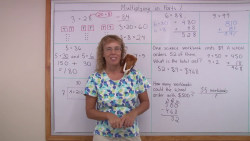
Partial products means we multiply numbers part-by-part. For example, 5 x 36 is done as 5 x 30 and 5 x 6, and those two parts are added. You can quite easily do these in your head when one number has two digits and the other has one. This concept is very important, as it is the basis for the regular multi-digit multiplication algorithm studied in 4th grade. I also teach it in my book Math Mammoth Multiplication 2 at - available both as an inexpensive download ($5.10) and as a printed copy.
More
0 /10
0 people rated
Partial products - multiplying in parts
2022
R
0 h 34 m
संयुक्त राज्य किंगडम
गणित
Partial products means we multiply numbers part-by-part. For example, 5 x 36 is done as 5 x 30 and 5 x 6, and those two parts are added. You can quite easily do these in your head when one number has two digits and the other has one. This concept is very important, as it is the basis for the regular multi-digit multiplication algorithm studied in 4th grade. I also teach it in my book Math Mammoth Multiplication 2 at - available both as an inexpensive download ($5.10) and as a printed copy.
More
0 /10
0 people rated
ऑनलाइन देखें
ऐप में देखें
Watch on TV
एपिसोड
शीर्ष कलाकार
उपयोगकर्ता समीक्षा
एपिसोड
शीर्ष कलाकार
उपयोगकर्ता समीक्षा
एपिसोड
film
lklk
Netflix
Plex
उपयोगकर्ता समीक्षा
user9383419145485
22/10/2025 21:18
We can think of 8 x 7 (for example) as 5 groups of 7 plus 2 groups of 7. In other words, we break down the product 8 x 7 into parts, into "partial products". This is easily illustrated with an array. Using partial products, or multiplying by parts, allows us to do multiplications such as 15 x 7 using mental math. It goes like this: 15 x 7 is 10 x 7 plus 5 x 7, which equals 70 + 35 = 105. There are other ways, too! Math Mammoth Grade 3 curriculum Multiplying with the Area Model (online activity)
Chelsie M
22/10/2025 21:18
We can think of 8 x 7 (for example) as 5 groups of 7 plus 2 groups of 7. In other words, we break down the product 8 x 7 into parts, into "partial products". This is easily illustrated with an array. Using partial products, or multiplying by parts, allows us to do multiplications such as 15 x 7 using mental math. It goes like this: 15 x 7 is 10 x 7 plus 5 x 7, which equals 70 + 35 = 105. There are other ways, too! Math Mammoth Grade 3 curriculum Multiplying with the Area Model (online activity)
Kamene Goro
22/10/2025 21:18
We can also divide in parts (not only multiply). Simply think of the quotient as consisting of a sum or difference, and divide each part separately. For example, 824 / 4 can be done as (800/4) + (24/4), and that can easily be done in your head. The reason we can do so boils down to the distributive property, and the fact that each division can be written as a multiplication. This lesson is part of the Math Mammoth Grade 6 curriculum. Find out more: See more 6th grade math videos:
Skales
22/10/2025 21:18
We can also divide in parts (not only multiply). Simply think of the quotient as consisting of a sum or difference, and divide each part separately. For example, 824 / 4 can be done as (800/4) + (24/4), and that can easily be done in your head. The reason we can do so boils down to the distributive property, and the fact that each division can be written as a multiplication. This lesson is part of the Math Mammoth Grade 6 curriculum. Find out more: See more 6th grade math videos:
merryriana
22/10/2025 21:18
I show how to solve a 2-digit by 2-digit multiplication problem with the partial products algorithm. You can see the same multiplication illustrated with an area model here: This lesson is part of the Math Mammoth Grade 6 curriculum. Learn more: See more 6th grade math videos:
user4121114070630
22/10/2025 21:18
I show how to solve a 2-digit by 2-digit multiplication problem with the partial products algorithm. You can see the same multiplication illustrated with an area model here: This lesson is part of the Math Mammoth Grade 6 curriculum. Learn more: See more 6th grade math videos:
Mauriiciia Lepfoundz
22/10/2025 21:18
The partial products algorithm allows anyone (even students who are "bad" at math) to learn how to multiply 2- and 3-digit numbers! It is also easy to see why it works. You don't have to be a math whiz! Partial products means that we multiply in part-by-part. For example, 7 x 534 is done as 7 x 500, 7 x 30, and 7 x 4, and lastly those parts are added. This topic is also explained (along with practice problems) in my book Math Mammoth Multiplication 2 at - available both as an inexpensive download ($5.10) and as a printed copy.
الفنان نور الزين
22/10/2025 21:18
The partial products algorithm allows anyone (even students who are "bad" at math) to learn how to multiply 2- and 3-digit numbers! It is also easy to see why it works. You don't have to be a math whiz! Partial products means that we multiply in part-by-part. For example, 7 x 534 is done as 7 x 500, 7 x 30, and 7 x 4, and lastly those parts are added. This topic is also explained (along with practice problems) in my book Math Mammoth Multiplication 2 at - available both as an inexpensive download ($5.10) and as a printed copy.
SocialIntrovert3020
22/10/2025 21:18
The area of a two-part rectangle gives us a simple visual model to illustrate partial products (the distributive property), here called "multiplying in parts". This video belongs to a lesson from the Math Mammoth Grade 6 curriculum. See more math videos for 6th grade:
Moyu
22/10/2025 21:18
The area of a two-part rectangle gives us a simple visual model to illustrate partial products (the distributive property), here called "multiplying in parts". This video belongs to a lesson from the Math Mammoth Grade 6 curriculum. See more math videos for 6th grade:
उपयोगकर्ता समीक्षा
user9383419145485
22/10/2025 21:18
We can think of 8 x 7 (for example) as 5 groups of 7 plus 2 groups of 7. In other words, we break down the product 8 x 7 into parts, into "partial products". This is easily illustrated with an array. Using partial products, or multiplying by parts, allows us to do multiplications such as 15 x 7 using mental math. It goes like this: 15 x 7 is 10 x 7 plus 5 x 7, which equals 70 + 35 = 105. There are other ways, too! Math Mammoth Grade 3 curriculum Multiplying with the Area Model (online activity)
Chelsie M
22/10/2025 21:18
We can think of 8 x 7 (for example) as 5 groups of 7 plus 2 groups of 7. In other words, we break down the product 8 x 7 into parts, into "partial products". This is easily illustrated with an array. Using partial products, or multiplying by parts, allows us to do multiplications such as 15 x 7 using mental math. It goes like this: 15 x 7 is 10 x 7 plus 5 x 7, which equals 70 + 35 = 105. There are other ways, too! Math Mammoth Grade 3 curriculum Multiplying with the Area Model (online activity)
Kamene Goro
22/10/2025 21:18
We can also divide in parts (not only multiply). Simply think of the quotient as consisting of a sum or difference, and divide each part separately. For example, 824 / 4 can be done as (800/4) + (24/4), and that can easily be done in your head. The reason we can do so boils down to the distributive property, and the fact that each division can be written as a multiplication. This lesson is part of the Math Mammoth Grade 6 curriculum. Find out more: See more 6th grade math videos:
Skales
22/10/2025 21:18
We can also divide in parts (not only multiply). Simply think of the quotient as consisting of a sum or difference, and divide each part separately. For example, 824 / 4 can be done as (800/4) + (24/4), and that can easily be done in your head. The reason we can do so boils down to the distributive property, and the fact that each division can be written as a multiplication. This lesson is part of the Math Mammoth Grade 6 curriculum. Find out more: See more 6th grade math videos:
merryriana
22/10/2025 21:18
I show how to solve a 2-digit by 2-digit multiplication problem with the partial products algorithm. You can see the same multiplication illustrated with an area model here: This lesson is part of the Math Mammoth Grade 6 curriculum. Learn more: See more 6th grade math videos:
user4121114070630
22/10/2025 21:18
I show how to solve a 2-digit by 2-digit multiplication problem with the partial products algorithm. You can see the same multiplication illustrated with an area model here: This lesson is part of the Math Mammoth Grade 6 curriculum. Learn more: See more 6th grade math videos:
Mauriiciia Lepfoundz
22/10/2025 21:18
The partial products algorithm allows anyone (even students who are "bad" at math) to learn how to multiply 2- and 3-digit numbers! It is also easy to see why it works. You don't have to be a math whiz! Partial products means that we multiply in part-by-part. For example, 7 x 534 is done as 7 x 500, 7 x 30, and 7 x 4, and lastly those parts are added. This topic is also explained (along with practice problems) in my book Math Mammoth Multiplication 2 at - available both as an inexpensive download ($5.10) and as a printed copy.
الفنان نور الزين
22/10/2025 21:18
The partial products algorithm allows anyone (even students who are "bad" at math) to learn how to multiply 2- and 3-digit numbers! It is also easy to see why it works. You don't have to be a math whiz! Partial products means that we multiply in part-by-part. For example, 7 x 534 is done as 7 x 500, 7 x 30, and 7 x 4, and lastly those parts are added. This topic is also explained (along with practice problems) in my book Math Mammoth Multiplication 2 at - available both as an inexpensive download ($5.10) and as a printed copy.
SocialIntrovert3020
22/10/2025 21:18
The area of a two-part rectangle gives us a simple visual model to illustrate partial products (the distributive property), here called "multiplying in parts". This video belongs to a lesson from the Math Mammoth Grade 6 curriculum. See more math videos for 6th grade:
Moyu
22/10/2025 21:18
The area of a two-part rectangle gives us a simple visual model to illustrate partial products (the distributive property), here called "multiplying in parts". This video belongs to a lesson from the Math Mammoth Grade 6 curriculum. See more math videos for 6th grade:
Disclaimer: All videos and pictures on MovieBox are from the Internet, and their copyrights belong to the original creators. We only provide webpage services and do not store, record, or upload any content.


 बिना रुकावट फिल्में और शो देखें
 अपना पसंदीदा कंटेंट डाउनलोड करो ताकि ऑफ़लाइन देख सको
 सिंपल इंटरफ़ेस & स्मूथ परफॉर्मेंस
'%20stroke-width='1.5'/%3e%3cpath%20d='M7%2017H13M10%2014.75V17'%20stroke='url(%23paint1)'%20stroke-width='1.5'%20stroke-linecap='round'/%3e%3cpath%20d='M10%206V11M10%2011L12%209M10%2011L8%209'%20stroke='url(%23paint2)'%20stroke-width='1.5'%20stroke-linecap='round'%20stroke-linejoin='round'/%3e%3cdefs%3e%3clinearGradient%20id='paint0'%20x1='2'%20y1='9'%20x2='18'%20y2='9'%20gradientUnits='userSpaceOnUse'%3e%3cstop%20stop-color='%231CB7FF'/%3e%3cstop%20offset='0.5'%20stop-color='%232FF58B'/%3e%3c/linearGradient%3e%3clinearGradient%20id='paint1'%20x1='7'%20y1='15.9'%20x2='13'%20y2='15.9'%20gradientUnits='userSpaceOnUse'%3e%3cstop%20stop-color='%231CB7FF'/%3e%3cstop%20offset='0.5'%20stop-color='%232FF58B'/%3e%3c/linearGradient%3e%3clinearGradient%20id='paint2'%20x1='8'%20y1='8.5'%20x2='12'%20y2='8.5'%20gradientUnits='userSpaceOnUse'%3e%3cstop%20stop-color='%231CB7FF'/%3e%3cstop%20offset='0.5'%20stop-color='%232FF58B'/%3e%3c/linearGradient%3e%3c/defs%3e%3c/svg%3e)
'/%3e%3cdefs%3e%3clinearGradient%20id='paint0'%20x1='2.5'%20y1='10'%20x2='17.5'%20y2='10'%20gradientUnits='userSpaceOnUse'%3e%3cstop%20stop-color='%231CB7FF'/%3e%3cstop%20offset='0.5'%20stop-color='%232FF58B'/%3e%3c/linearGradient%3e%3c/defs%3e%3c/svg%3e)




'%3e%3cpath%20id='Vector'%20d='M17.3996%2025.7999C17.3996%2025.9838%2017.3634%2026.1658%2017.293%2026.3357C17.2227%2026.5055%2017.1196%2026.6598%2016.9896%2026.7899C16.8596%2026.9199%2016.7052%2027.023%2016.5354%2027.0933C16.3655%2027.1637%2016.1835%2027.1999%2015.9996%2027.1999C15.8158%2027.1999%2015.6337%2027.1637%2015.4639%2027.0933C15.294%2027.023%2015.1397%2026.9199%2015.0097%2026.7899C14.8797%2026.6598%2014.7765%2026.5055%2014.7062%2026.3357C14.6358%2026.1658%2014.5996%2025.9838%2014.5996%2025.7999C14.5996%2025.4286%2014.7471%2025.0725%2015.0097%2024.81C15.2722%2024.5474%2015.6283%2024.3999%2015.9996%2024.3999C16.3709%2024.3999%2016.727%2024.5474%2016.9896%2024.81C17.2521%2025.0725%2017.3996%2025.4286%2017.3996%2025.7999Z'%20fill='white'/%3e%3cpath%20id='Union'%20fill-rule='evenodd'%20clip-rule='evenodd'%20d='M8.5%204H23.5C24.0523%204%2024.5%204.44772%2024.5%205V21.5H7.5V5C7.5%204.44772%207.94772%204%208.5%204ZM5.5%2022.5V5C5.5%203.34315%206.84315%202%208.5%202H23.5C25.1569%202%2026.5%203.34315%2026.5%205V22.5V27C26.5%2028.6569%2025.1569%2030%2023.5%2030H8.5C6.84315%2030%205.5%2028.6569%205.5%2027V22.5ZM24.5%2023.5V27C24.5%2027.5523%2024.0523%2028%2023.5%2028H8.5C7.94772%2028%207.5%2027.5523%207.5%2027V23.5H24.5Z'%20fill='white'/%3e%3cpath%20id='Union_2'%20fill-rule='evenodd'%20clip-rule='evenodd'%20d='M17%209C17%208.44772%2016.5523%208%2016%208C15.4477%208%2015%208.44772%2015%209V13.8258L13.1508%2012.2407C12.7315%2011.8813%2012.1002%2011.9299%2011.7408%2012.3492C11.3813%2012.7685%2011.4299%2013.3998%2011.8492%2013.7593L15.345%2016.7556C15.5205%2016.9079%2015.7495%2017%2016%2017C16.2506%2017%2016.4796%2016.9079%2016.6551%2016.7556L20.1508%2013.7593C20.5701%2013.3998%2020.6187%2012.7685%2020.2593%2012.3492C19.8999%2011.9299%2019.2686%2011.8813%2018.8492%2012.2407L17%2013.8258V9Z'%20fill='white'/%3e%3c/g%3e%3c/svg%3e)