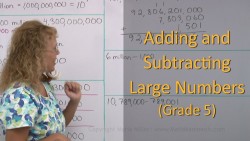
In this lesson, we add and subtract large numbers (with up to 9 digits, or with billions), both using mental math and in columns (one number under the other). The main principle to keep in mind is that the different places in the number need to be aligned: ones with ones, tens with tens, hundreds with hundreds, etc. all the way to hundred billions. Other than that, there's not really anything new to learn: the basic addition and subtraction algorithms (including regrouping) work the same way as with smaller numbers.
More
0 /10
0 people rated
Large numbers and the calculator - 5th grade
2019
R
0 h 41 m
المملكة المتحدة
الرياضيات
In this lesson, we add and subtract large numbers (with up to 9 digits, or with billions), both using mental math and in columns (one number under the other). The main principle to keep in mind is that the different places in the number need to be aligned: ones with ones, tens with tens, hundreds with hundreds, etc. all the way to hundred billions. Other than that, there's not really anything new to learn: the basic addition and subtraction algorithms (including regrouping) work the same way as with smaller numbers.
More
0 /10
0 people rated
شاهد أونلاين
شاهد في التطبيق
Watch on TV
الحلقات
أفضل الممثلين
تقييمات المستخدمين
الحلقات
أفضل الممثلين
تقييمات المستخدمين
الحلقات
film
lklk
Netflix
Plex
تقييمات المستخدمين
❤️𝓨𝓪𝓼𝓼𝓮𝓻 &𝓵𝓾𝓬𝓲𝓮❤️
22/10/2025 20:51
We look at two example math word problems where a calculator is useful. The first one has to do with average speed. The second one asks us the average miles per capita (per person) driven in the United States in one year, and also in one day. I feel 5th grade is a good time to teach students how to use a calculator. These examples can help students understand when to use a calculator. However, I don't recommend a calculator to be used for simple calculations that can be done mentally. See also this video: How to use a calculator to find powers of 7
Batoul Nazzal Tannir
22/10/2025 20:51
We look at two example math word problems where a calculator is useful. The first one has to do with average speed. The second one asks us the average miles per capita (per person) driven in the United States in one year, and also in one day. I feel 5th grade is a good time to teach students how to use a calculator. These examples can help students understand when to use a calculator. However, I don't recommend a calculator to be used for simple calculations that can be done mentally. See also this video: How to use a calculator to find powers of 7
Shanaya Santos
22/10/2025 20:51
In this example, we find which exact power of seven is more than one million, using a calculator. This is a simple exercise helping students to learn to use the calculator. Once you punch 7 x 7 = with a calculator, and get 49, you can just keep pushing the equals button, which will multiply your previous result by 7. And thus, you can get a sequence of numbers that are powers of 7... 7 to the third power, 7 to the fourth power, 7 to the fifth power (exponent is 5) and so on. See more 5th grade math videos at
Fanell Nguema
22/10/2025 20:51
In this example, we find which exact power of seven is more than one million, using a calculator. This is a simple exercise helping students to learn to use the calculator. Once you punch 7 x 7 = with a calculator, and get 49, you can just keep pushing the equals button, which will multiply your previous result by 7. And thus, you can get a sequence of numbers that are powers of 7... 7 to the third power, 7 to the fourth power, 7 to the fifth power (exponent is 5) and so on. See more 5th grade math videos at
wissal marcelo
22/10/2025 20:51
Some basic practice with rounding large numbers (with millions) to any place, including numbers with lots of nines. We also look at two word problems.
Djubi carimo
22/10/2025 20:51
Some basic practice with rounding large numbers (with millions) to any place, including numbers with lots of nines. We also look at two word problems.
noura_med
22/10/2025 20:51
This is an introduction to powers of ten and to exponents, as studied in 5th grade math. A power of ten means that ten is multiplied by itself, a certain number of times. For example, ten to the 6th power means 10 x 10 x 10 x 10 x 10 x 10, or one million. In this lesson, we also look at multiplying other numbers by powers of ten, such as 41 x 10^4 or similar expressions. Lastly we consider some large numbers from astronomy, and how powers of ten (exponents) really help us write those numbers!
Khanbdfenikhan
22/10/2025 20:51
This is an introduction to powers of ten and to exponents, as studied in 5th grade math. A power of ten means that ten is multiplied by itself, a certain number of times. For example, ten to the 6th power means 10 x 10 x 10 x 10 x 10 x 10, or one million. In this lesson, we also look at multiplying other numbers by powers of ten, such as 41 x 10^4 or similar expressions. Lastly we consider some large numbers from astronomy, and how powers of ten (exponents) really help us write those numbers!
Xibonecana
22/10/2025 20:51
In this lesson, we add and subtract large numbers (with up to 9 digits, or with billions), both using mental math and in columns (one number under the other). The main principle to keep in mind is that the different places in the number need to be aligned: ones with ones, tens with tens, hundreds with hundreds, etc. all the way to hundred billions. Other than that, there's not really anything new to learn: the basic addition and subtraction algorithms (including regrouping) work the same way as with smaller numbers.
Dayana Otha
22/10/2025 20:51
In this lesson, we add and subtract large numbers (with up to 9 digits, or with billions), both using mental math and in columns (one number under the other). The main principle to keep in mind is that the different places in the number need to be aligned: ones with ones, tens with tens, hundreds with hundreds, etc. all the way to hundred billions. Other than that, there's not really anything new to learn: the basic addition and subtraction algorithms (including regrouping) work the same way as with smaller numbers.
— No more content —
Disclaimer: All videos and pictures on MovieBox are from the Internet, and their copyrights belong to the original creators. We only provide webpage services and do not store, record, or upload any content.


 استمتع بأفلام وبرامج بلا حدود
 حمل ما تحب وشاهد بدون إنترنت
 واجهة بسيطة وأداء سلس