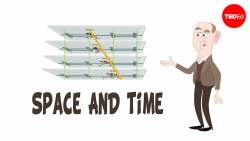
View full lesson: Space is where things happen. Time is when things happen. And sometimes, in order to really look at the universe, you need to take those two concepts and mash them together. In this first lesson of a three-part series on space-time, hilarious hosts Andrew Pontzen and Tom Whyntie go through the basics of space and time individually, and use a flip book to illustrate how we can begin to look at them together. Lesson by Andrew Pontzen and Tom Whyntie, animation by Giant Animation Studios.
More
0 /10
0 people rated
CERN + Space-Time 101
2018
R
0 h 13 m
المملكة المتحدة
TED
View full lesson: Space is where things happen. Time is when things happen. And sometimes, in order to really look at the universe, you need to take those two concepts and mash them together. In this first lesson of a three-part series on space-time, hilarious hosts Andrew Pontzen and Tom Whyntie go through the basics of space and time individually, and use a flip book to illustrate how we can begin to look at them together. Lesson by Andrew Pontzen and Tom Whyntie, animation by Giant Animation Studios.
More
0 /10
0 people rated
شاهد أونلاين
شاهد في التطبيق
Watch on TV
الحلقات
أفضل الممثلين
تقييمات المستخدمين
الحلقات
أفضل الممثلين
تقييمات المستخدمين
الحلقات
film
lklk
Netflix
Plex
تقييمات المستخدمين
Tigopoundz
17/06/2026 04:59
View full lesson: http://ed.ted.com/lessons/the-fundamentals-of-space-time-part-3-andrew-pontzen-and-tom-whyntie
View part 1: http://ed.ted.com/lessons/the-fundamentals-of-space-time-part-1-andrew-pontzen-and-tom-whyntie
View part 2: http://ed.ted.com/lessons/the-fundamentals-of-space-time-part-2-andrew-pontzen-and-tom-whyntie
In the first two lessons of this series on space-time, we've dealt with objects moving at constant speeds, with straight world lines, in space-time. But what happens when you throw gravity into the mix? In this third and final lesson, CERN scientists Andrew Pontzen and Tom Whyntie explore what gravity means for space-time -- or rather, what space-time means for gravity.
Lesson by Andrew Pontzen and Tom Whyntie, animation by Giant Animation Studios.
Rakesh reddy
17/06/2026 04:49
View full lesson: http://ed.ted.com/lessons/the-fundamentals-of-space-time-part-2-andrew-pontzen-and-tom-whyntie
View part 1 here: http://ed.ted.com/lessons/the-fundamentals-of-space-time-part-1-andrew-pontzen-and-tom-whyntie
Light always travels at a speed of 299,792,458 meters per second. But if you're in motion too, you're going to perceive it as traveling even faster -- which isn't possible! In this second installment of a three-part series on space-time, CERN scientists Andrew Pontzen and Tom Whyntie use a space-time diagram to analyze the sometimes confounding motion of light.
Lesson by Andrew Pontzen and Tom Whyntie, animation by Giant Animation.
Baba Bocoum
22/10/2025 08:13
View full lesson: View part 1: View part 2: In the first two lessons of this series on space-time, we've dealt with objects moving at constant speeds, with straight world lines, in space-time. But what happens when you throw gravity into the mix? In this third and final lesson, CERN scientists Andrew Pontzen and Tom Whyntie explore what gravity means for space-time -- or rather, what space-time means for gravity. Lesson by Andrew Pontzen and Tom Whyntie, animation by Giant Animation Studios.
himanshu yadav
22/10/2025 08:13
View full lesson: View part 1: View part 2: In the first two lessons of this series on space-time, we've dealt with objects moving at constant speeds, with straight world lines, in space-time. But what happens when you throw gravity into the mix? In this third and final lesson, CERN scientists Andrew Pontzen and Tom Whyntie explore what gravity means for space-time -- or rather, what space-time means for gravity. Lesson by Andrew Pontzen and Tom Whyntie, animation by Giant Animation Studios.
Eliza Giovanni
22/10/2025 08:13
View full lesson: View part 1 here: Light always travels at a speed of 299,792,458 meters per second. But if you're in motion too, you're going to perceive it as traveling even faster -- which isn't possible! In this second installment of a three-part series on space-time, CERN scientists Andrew Pontzen and Tom Whyntie use a space-time diagram to analyze the sometimes confounding motion of light. Lesson by Andrew Pontzen and Tom Whyntie, animation by Giant Animation.
Hama9a🤪🤪فكاهة😜
22/10/2025 08:13
View full lesson: View part 1 here: Light always travels at a speed of 299,792,458 meters per second. But if you're in motion too, you're going to perceive it as traveling even faster -- which isn't possible! In this second installment of a three-part series on space-time, CERN scientists Andrew Pontzen and Tom Whyntie use a space-time diagram to analyze the sometimes confounding motion of light. Lesson by Andrew Pontzen and Tom Whyntie, animation by Giant Animation.
Ayoub Daou
22/10/2025 08:13
View full lesson: Space is where things happen. Time is when things happen. And sometimes, in order to really look at the universe, you need to take those two concepts and mash them together. In this first lesson of a three-part series on space-time, hilarious hosts Andrew Pontzen and Tom Whyntie go through the basics of space and time individually, and use a flip book to illustrate how we can begin to look at them together. Lesson by Andrew Pontzen and Tom Whyntie, animation by Giant Animation Studios.
Sufiyan H Dhendhen
22/10/2025 08:13
View full lesson: Space is where things happen. Time is when things happen. And sometimes, in order to really look at the universe, you need to take those two concepts and mash them together. In this first lesson of a three-part series on space-time, hilarious hosts Andrew Pontzen and Tom Whyntie go through the basics of space and time individually, and use a flip book to illustrate how we can begin to look at them together. Lesson by Andrew Pontzen and Tom Whyntie, animation by Giant Animation Studios.
— No more content —
تقييمات المستخدمين
Tigopoundz
17/06/2026 04:59
View full lesson: http://ed.ted.com/lessons/the-fundamentals-of-space-time-part-3-andrew-pontzen-and-tom-whyntie
View part 1: http://ed.ted.com/lessons/the-fundamentals-of-space-time-part-1-andrew-pontzen-and-tom-whyntie
View part 2: http://ed.ted.com/lessons/the-fundamentals-of-space-time-part-2-andrew-pontzen-and-tom-whyntie
In the first two lessons of this series on space-time, we've dealt with objects moving at constant speeds, with straight world lines, in space-time. But what happens when you throw gravity into the mix? In this third and final lesson, CERN scientists Andrew Pontzen and Tom Whyntie explore what gravity means for space-time -- or rather, what space-time means for gravity.
Lesson by Andrew Pontzen and Tom Whyntie, animation by Giant Animation Studios.
Rakesh reddy
17/06/2026 04:49
View full lesson: http://ed.ted.com/lessons/the-fundamentals-of-space-time-part-2-andrew-pontzen-and-tom-whyntie
View part 1 here: http://ed.ted.com/lessons/the-fundamentals-of-space-time-part-1-andrew-pontzen-and-tom-whyntie
Light always travels at a speed of 299,792,458 meters per second. But if you're in motion too, you're going to perceive it as traveling even faster -- which isn't possible! In this second installment of a three-part series on space-time, CERN scientists Andrew Pontzen and Tom Whyntie use a space-time diagram to analyze the sometimes confounding motion of light.
Lesson by Andrew Pontzen and Tom Whyntie, animation by Giant Animation.
Baba Bocoum
22/10/2025 08:13
View full lesson: View part 1: View part 2: In the first two lessons of this series on space-time, we've dealt with objects moving at constant speeds, with straight world lines, in space-time. But what happens when you throw gravity into the mix? In this third and final lesson, CERN scientists Andrew Pontzen and Tom Whyntie explore what gravity means for space-time -- or rather, what space-time means for gravity. Lesson by Andrew Pontzen and Tom Whyntie, animation by Giant Animation Studios.
himanshu yadav
22/10/2025 08:13
View full lesson: View part 1: View part 2: In the first two lessons of this series on space-time, we've dealt with objects moving at constant speeds, with straight world lines, in space-time. But what happens when you throw gravity into the mix? In this third and final lesson, CERN scientists Andrew Pontzen and Tom Whyntie explore what gravity means for space-time -- or rather, what space-time means for gravity. Lesson by Andrew Pontzen and Tom Whyntie, animation by Giant Animation Studios.
Eliza Giovanni
22/10/2025 08:13
View full lesson: View part 1 here: Light always travels at a speed of 299,792,458 meters per second. But if you're in motion too, you're going to perceive it as traveling even faster -- which isn't possible! In this second installment of a three-part series on space-time, CERN scientists Andrew Pontzen and Tom Whyntie use a space-time diagram to analyze the sometimes confounding motion of light. Lesson by Andrew Pontzen and Tom Whyntie, animation by Giant Animation.
Hama9a🤪🤪فكاهة😜
22/10/2025 08:13
View full lesson: View part 1 here: Light always travels at a speed of 299,792,458 meters per second. But if you're in motion too, you're going to perceive it as traveling even faster -- which isn't possible! In this second installment of a three-part series on space-time, CERN scientists Andrew Pontzen and Tom Whyntie use a space-time diagram to analyze the sometimes confounding motion of light. Lesson by Andrew Pontzen and Tom Whyntie, animation by Giant Animation.
Ayoub Daou
22/10/2025 08:13
View full lesson: Space is where things happen. Time is when things happen. And sometimes, in order to really look at the universe, you need to take those two concepts and mash them together. In this first lesson of a three-part series on space-time, hilarious hosts Andrew Pontzen and Tom Whyntie go through the basics of space and time individually, and use a flip book to illustrate how we can begin to look at them together. Lesson by Andrew Pontzen and Tom Whyntie, animation by Giant Animation Studios.
Sufiyan H Dhendhen
22/10/2025 08:13
View full lesson: Space is where things happen. Time is when things happen. And sometimes, in order to really look at the universe, you need to take those two concepts and mash them together. In this first lesson of a three-part series on space-time, hilarious hosts Andrew Pontzen and Tom Whyntie go through the basics of space and time individually, and use a flip book to illustrate how we can begin to look at them together. Lesson by Andrew Pontzen and Tom Whyntie, animation by Giant Animation Studios.
— No more content —
Disclaimer: All videos and pictures on MovieBox are from the Internet, and their copyrights belong to the original creators. We only provide webpage services and do not store, record, or upload any content.


 استمتع بأفلام وبرامج بلا حدود
 حمل ما تحب وشاهد بدون إنترنت
 واجهة بسيطة وأداء سلس
'%20stroke-width='1.5'/%3e%3cpath%20d='M7%2017H13M10%2014.75V17'%20stroke='url(%23paint1)'%20stroke-width='1.5'%20stroke-linecap='round'/%3e%3cpath%20d='M10%206V11M10%2011L12%209M10%2011L8%209'%20stroke='url(%23paint2)'%20stroke-width='1.5'%20stroke-linecap='round'%20stroke-linejoin='round'/%3e%3cdefs%3e%3clinearGradient%20id='paint0'%20x1='2'%20y1='9'%20x2='18'%20y2='9'%20gradientUnits='userSpaceOnUse'%3e%3cstop%20stop-color='%231CB7FF'/%3e%3cstop%20offset='0.5'%20stop-color='%232FF58B'/%3e%3c/linearGradient%3e%3clinearGradient%20id='paint1'%20x1='7'%20y1='15.9'%20x2='13'%20y2='15.9'%20gradientUnits='userSpaceOnUse'%3e%3cstop%20stop-color='%231CB7FF'/%3e%3cstop%20offset='0.5'%20stop-color='%232FF58B'/%3e%3c/linearGradient%3e%3clinearGradient%20id='paint2'%20x1='8'%20y1='8.5'%20x2='12'%20y2='8.5'%20gradientUnits='userSpaceOnUse'%3e%3cstop%20stop-color='%231CB7FF'/%3e%3cstop%20offset='0.5'%20stop-color='%232FF58B'/%3e%3c/linearGradient%3e%3c/defs%3e%3c/svg%3e)
'/%3e%3cdefs%3e%3clinearGradient%20id='paint0'%20x1='2.5'%20y1='10'%20x2='17.5'%20y2='10'%20gradientUnits='userSpaceOnUse'%3e%3cstop%20stop-color='%231CB7FF'/%3e%3cstop%20offset='0.5'%20stop-color='%232FF58B'/%3e%3c/linearGradient%3e%3c/defs%3e%3c/svg%3e)




'%3e%3cpath%20id='Vector'%20d='M17.3996%2025.7999C17.3996%2025.9838%2017.3634%2026.1658%2017.293%2026.3357C17.2227%2026.5055%2017.1196%2026.6598%2016.9896%2026.7899C16.8596%2026.9199%2016.7052%2027.023%2016.5354%2027.0933C16.3655%2027.1637%2016.1835%2027.1999%2015.9996%2027.1999C15.8158%2027.1999%2015.6337%2027.1637%2015.4639%2027.0933C15.294%2027.023%2015.1397%2026.9199%2015.0097%2026.7899C14.8797%2026.6598%2014.7765%2026.5055%2014.7062%2026.3357C14.6358%2026.1658%2014.5996%2025.9838%2014.5996%2025.7999C14.5996%2025.4286%2014.7471%2025.0725%2015.0097%2024.81C15.2722%2024.5474%2015.6283%2024.3999%2015.9996%2024.3999C16.3709%2024.3999%2016.727%2024.5474%2016.9896%2024.81C17.2521%2025.0725%2017.3996%2025.4286%2017.3996%2025.7999Z'%20fill='white'/%3e%3cpath%20id='Union'%20fill-rule='evenodd'%20clip-rule='evenodd'%20d='M8.5%204H23.5C24.0523%204%2024.5%204.44772%2024.5%205V21.5H7.5V5C7.5%204.44772%207.94772%204%208.5%204ZM5.5%2022.5V5C5.5%203.34315%206.84315%202%208.5%202H23.5C25.1569%202%2026.5%203.34315%2026.5%205V22.5V27C26.5%2028.6569%2025.1569%2030%2023.5%2030H8.5C6.84315%2030%205.5%2028.6569%205.5%2027V22.5ZM24.5%2023.5V27C24.5%2027.5523%2024.0523%2028%2023.5%2028H8.5C7.94772%2028%207.5%2027.5523%207.5%2027V23.5H24.5Z'%20fill='white'/%3e%3cpath%20id='Union_2'%20fill-rule='evenodd'%20clip-rule='evenodd'%20d='M17%209C17%208.44772%2016.5523%208%2016%208C15.4477%208%2015%208.44772%2015%209V13.8258L13.1508%2012.2407C12.7315%2011.8813%2012.1002%2011.9299%2011.7408%2012.3492C11.3813%2012.7685%2011.4299%2013.3998%2011.8492%2013.7593L15.345%2016.7556C15.5205%2016.9079%2015.7495%2017%2016%2017C16.2506%2017%2016.4796%2016.9079%2016.6551%2016.7556L20.1508%2013.7593C20.5701%2013.3998%2020.6187%2012.7685%2020.2593%2012.3492C19.8999%2011.9299%2019.2686%2011.8813%2018.8492%2012.2407L17%2013.8258V9Z'%20fill='white'/%3e%3c/g%3e%3c/svg%3e)